

Scaling a business is exciting, but growth without structure often creates more problems than opportunities. Many businesses experience rising costs, operational inefficiencies, communication breakdowns, and declining service quality as they grow.
The issue is rarely growth itself. The problem is scaling without a clear operational framework.
For businesses in manufacturing, engineering, healthcare, technology, logistics, and product development, sustainable growth depends on building systems that can handle increasing demand without creating chaos.
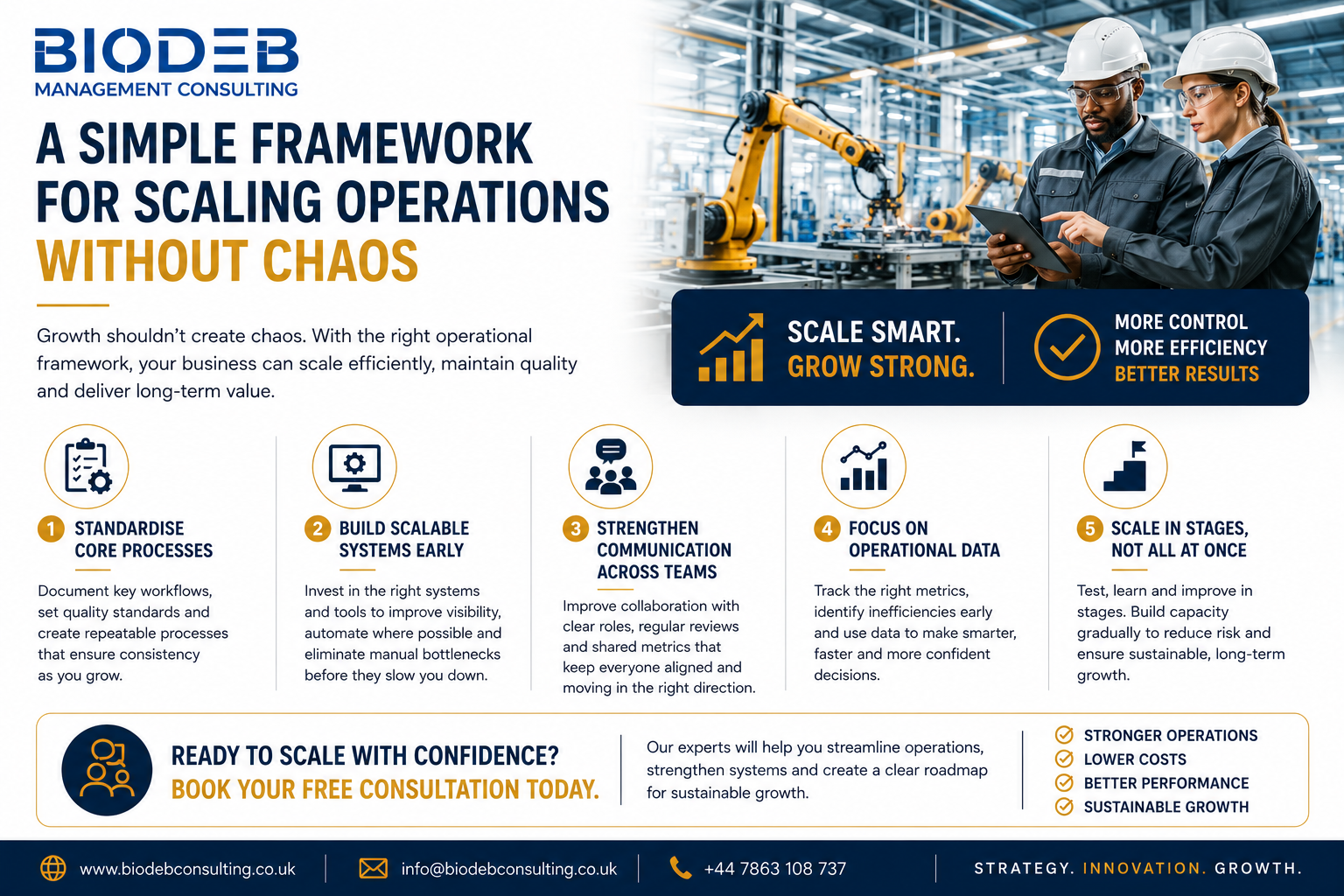
Here is a simple framework to scale operations effectively while maintaining control, efficiency, and quality.
1. Standardise Core Processes
Many growing businesses rely too heavily on informal workflows and individual knowledge.
As operations expand, this creates inconsistency, delays, and operational risk.
Start by documenting:
- Production workflows
- Supply chain procedures
- Customer service processes
- Reporting systems
- Quality control standards
Clear processes improve consistency, reduce errors, and make teams more efficient.
Standardisation also makes onboarding and training significantly easier as the business grows.
2. Build Scalable Systems Early
One of the biggest operational mistakes businesses make is waiting too long to improve systems.
Manual processes that work for a small team quickly become bottlenecks during growth.
Scalable businesses invest early in:
- Operational management systems
- Inventory tracking tools
- Manufacturing planning software
- CRM and reporting platforms
- Automation where appropriate
The goal is not complexity. It is visibility, control, and efficiency.
3. Strengthen Communication Across Teams
Growth often exposes communication gaps between departments.
Poor coordination between operations, procurement, production, and leadership teams leads to delays, duplication, and avoidable costs.
Businesses should establish:
- Clear reporting structures
- Regular operational reviews
- Defined responsibilities
- Shared performance metrics
Strong communication creates operational alignment and faster decision-making.
4. Focus on Operational Data
Scaling successfully requires data-driven decision-making.
Businesses that rely only on assumptions often miss inefficiencies until they become expensive problems.
Track key operational metrics such as:
- Production efficiency
- Delivery performance
- Downtime
- Material waste
- Customer satisfaction
- Cost per unit
Operational visibility allows businesses to identify issues early and scale more strategically.
5. Scale in Stages, Not All at Once
Rapid expansion without operational readiness creates unnecessary pressure on teams, systems, and cash flow.
A staged growth approach is more sustainable:
- Test new processes
- Validate operational capacity
- Improve systems incrementally
- Scale based on performance data
Controlled scaling reduces risk while maintaining service and product quality.
Final Thoughts
Scaling operations successfully is not about working harder. It is about building stronger systems, improving visibility, and creating operational discipline that supports long-term growth.
Businesses that scale effectively are usually the ones that prepare operationally before growth becomes difficult to manage.
At Biodeb Management Consulting, we help businesses optimise operations, improve efficiency, and develop scalable growth strategies across manufacturing, supply chain, engineering, and international markets.
If your business is preparing for growth or struggling with operational complexity, contact us today for a free consultation and discover how to scale with greater clarity, structure, and confidence.