

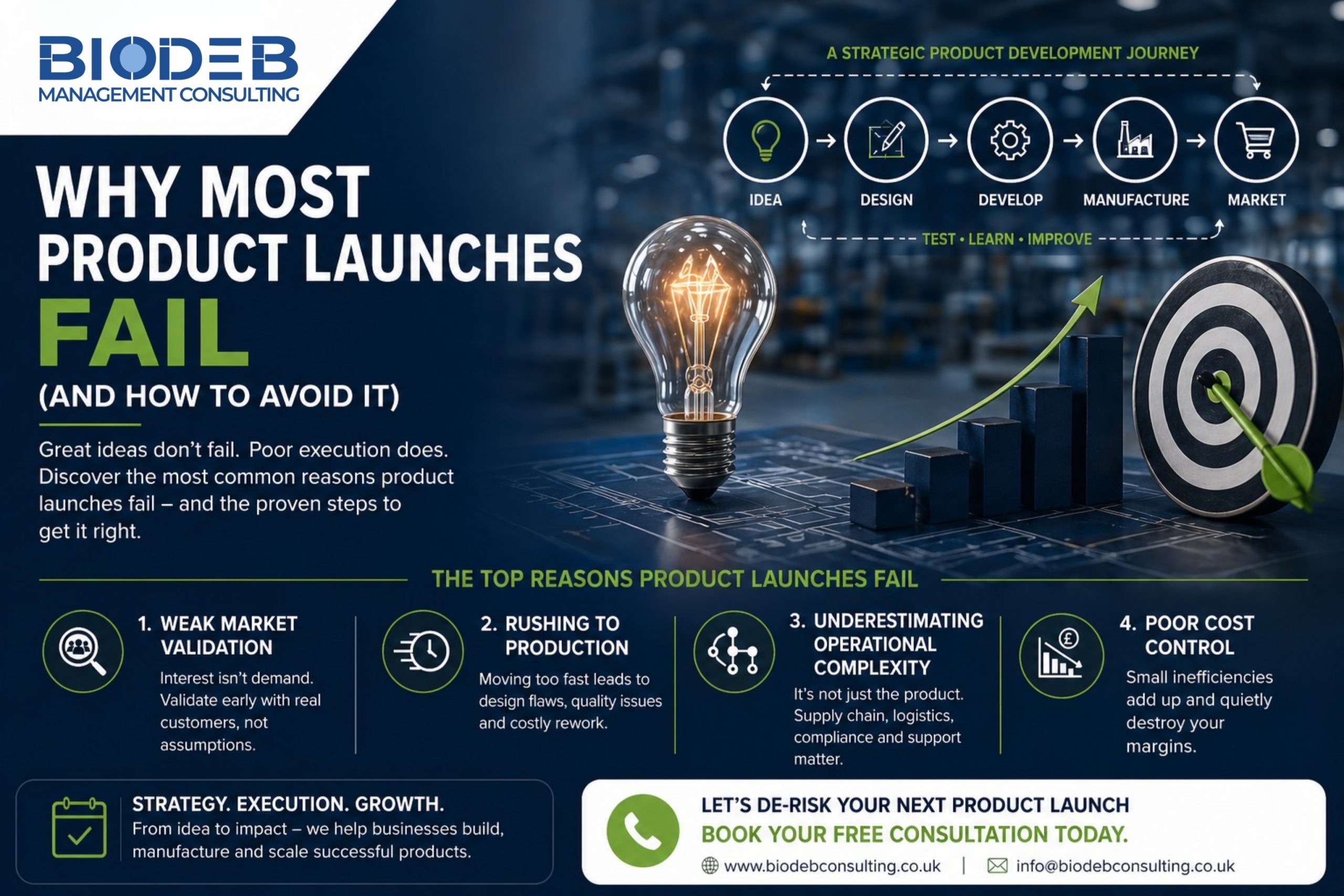
Why Most Product Launches Fail (and How to Avoid It)
Launching a new product looks straightforward on the surface. You develop an idea, build a prototype, find a manufacturer, and bring it to market. In reality, product development is rarely that linear. Across manufacturing, engineering, consumer goods, and tech-driven industries, most product launches fail not because of the idea itself, but because of gaps in execution, planning, and validation.
For businesses operating in competitive UK and international markets, especially those expanding into Africa or scaling production, understanding these failure points is essential.
Here’s what typically goes wrong and how to approach product development more strategically.
- Weak market validation
One of the most common reasons product launches fail is simple: the market was never properly tested.
Many businesses rely on feedback such as “this looks useful” or “I would buy this” from early conversations. But informal interest does not translate into demand. Without real validation, companies often invest heavily in tooling, manufacturing, and logistics before confirming whether customers will actually commit financially.
A more reliable approach is structured validation:
- Pre-orders or pilot sales
- Small batch testing in target markets
- Direct engagement with early adopters
This is especially important for businesses expanding into new regions such as African markets, where demand dynamics can differ significantly from the UK.
- Rushing from prototype to production
Speed is often treated as an advantage in product development, but premature scaling can be costly.
Moving too quickly into full production frequently leads to:
- Design flaws being discovered too late
- Quality control issues at scale
- Expensive retooling or redesigns
- Supplier misalignment
In manufacturing and engineering-led sectors, even small design adjustments after production has begun can have a significant financial impact.
A staged approach is far more effective:
prototype → pilot run → limited production → full scale manufacturing.
Each stage should validate both the product and the operational process behind it.
- Underestimating operational complexity
A successful product is not just about the product itself. It is about everything around it.
This includes:
- Supply chain reliability
- Manufacturing consistency
- Logistics and distribution
- Regulatory compliance
- After-sales support
Many businesses focus heavily on product design but underestimate how operational systems affect performance and profitability. This is particularly true for companies scaling across borders, where supply chain complexity increases significantly.
Without a structured operational plan, even strong products can struggle once they reach the market.
- Poor cost and margin control
Margins rarely collapse suddenly. They erode slowly through small inefficiencies.
Common issues include:
- Unoptimised manufacturing costs
- Inefficient supplier agreements
- Unexpected logistics expenses
- Poor forecasting leading to excess inventory
For SMEs and scaling businesses, these issues often only become visible once cash flow starts tightening.
A disciplined cost structure from the outset is critical. This includes clear unit economics, supplier benchmarking, and ongoing cost analysis as production scales.
How to improve your chances of success
Successful product launches tend to follow a consistent pattern:
Validate before you scale
Ensure real demand exists through tangible customer commitment, not assumptions.
Build in stages
Avoid jumping from concept to mass production. Controlled scaling reduces risk.
Design for operations, not just appearance
A good product must also be manufacturable, scalable, and cost-effective.
Think beyond borders early
If international expansion is part of your strategy, particularly into African markets, factor logistics, regulation, and localisation into the design phase.
Final thoughts
Product development is not just a creative process. It is a structured business discipline that blends engineering, operations, supply chain management, and market strategy.
The businesses that succeed are not always those with the best ideas, but those that execute with clarity, discipline, and realistic assumptions about scale.
At Biodeb Consulting, we work with businesses across the UK and international markets to reduce product development risk, optimise manufacturing processes, and support scalable growth strategies.
If you are planning a product launch or looking to improve your current development process, we offer a free initial consultation to help you identify risks, improve structure, and explore the most effective path to market.
Get in touch to discuss how we can support your product development and growth strategy.